Gas Was 25 Cents a Gallon — So Why Were Drivers Paying More Than You Think?
Gas Was 25 Cents a Gallon — So Why Were Drivers Paying More Than You Think?
Ask almost any American over 60 about gas prices, and you'll get some version of the same story: Back in my day, you could fill up for two dollars. It's one of the most durable pieces of economic nostalgia in the country — the cheap-gas era as proof that things used to be better, simpler, more affordable.
The only problem? When you actually run the numbers, the story gets a lot more complicated.
The Sticker Price Isn't the Whole Price
Let's start with the most obvious issue: inflation. A dollar in 1965 is not a dollar today. The U.S. Bureau of Labor Statistics' own inflation calculator shows that $1 in 1965 had the equivalent purchasing power of roughly $10 in 2024. Which means that 30-cent gallon of gasoline in 1965 actually cost the equivalent of about $3.00 in today's money — not far off from what many Americans paid at the pump for much of the 2010s.
But inflation adjustment is just the beginning. To really understand what gas cost across the decades, you need to factor in two more things: what cars actually consumed, and what Americans actually earned.
Decade by Decade: The Real Math
The 1950s — Cheap Gas, Thirsty Cars
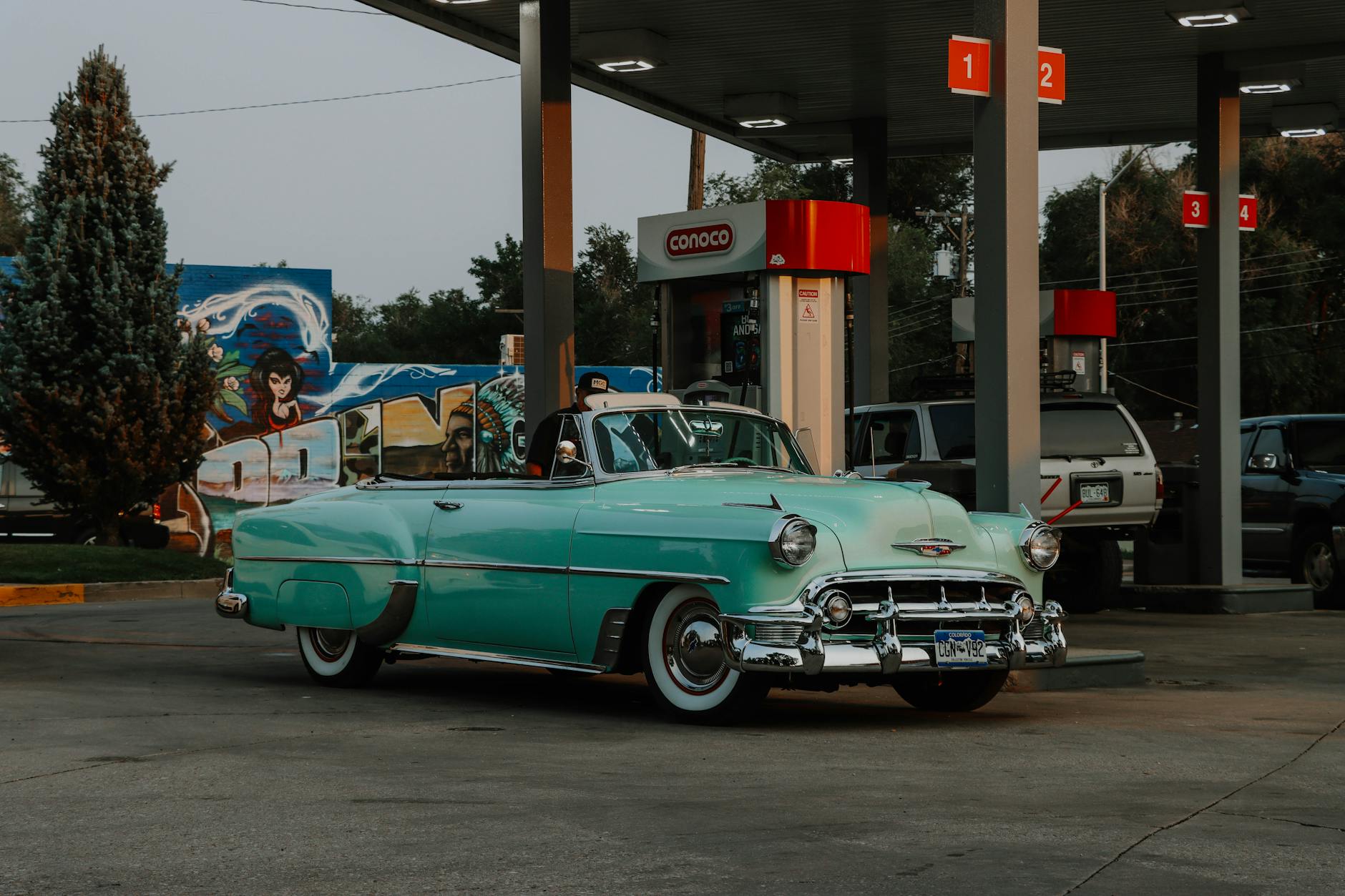
The postwar boom gave Americans two things simultaneously: rising wages and a love affair with large, powerful automobiles that drank fuel like it was going out of style. A 1955 Chevrolet Bel Air got roughly 15 miles per gallon on a good day. A V8-powered Ford or Plymouth might manage 12 to 14 mpg in real-world driving.
Gas averaged around 27 cents per gallon in 1955. Sounds wonderful. Except that the average American worker earned about $1.50 to $2.00 per hour. To fill a 20-gallon tank — a typical size for the era — you'd spend roughly $5.40, which represented nearly three full hours of work at median wages.
For comparison, filling a 2024 Toyota Camry (14-gallon tank, 32 mpg highway) at $3.50 per gallon costs about $49. The median American hourly wage today sits around $23 to $25. That's roughly two hours of work. The 1950s driver was working more hours to go fewer miles.
The 1960s — The Illusion Deepens
Gas prices stayed low through most of the 1960s, hovering around 30 to 33 cents per gallon. But cars weren't getting more efficient — if anything, the muscle car era was ramping up. A 1968 Ford Mustang with a 390 cubic-inch V8 returned fuel economy in the low teens. A Dodge Charger or Pontiac GTO was similar.
And these weren't small tanks. Many performance cars of the era carried 18 to 22 gallons. Filling up completely could cost $6 to $7 — in an era when a lot of working Americans were earning around $2.50 an hour. That's still roughly two and a half to three hours of labor per fill-up.
Adjusted for inflation, that 32-cent gallon in 1968 is worth about $2.80 today. Which is actually cheaper than current national averages — but paired with a car getting 13 mpg instead of 32, the cost per mile driven was dramatically higher.
The 1970s — The Crash That Woke Everyone Up
The 1973 OPEC oil embargo didn't just cause gas lines stretching around the block. It shattered the foundational myth that cheap fuel was a permanent feature of American life. Prices that had sat stable for two decades suddenly lurched upward — from around 38 cents per gallon in 1972 to over 55 cents by 1974, and then past $1.00 by the end of the decade.
In inflation-adjusted terms, the price spike of the late 1970s was genuinely brutal. Gas in 1979 cost the equivalent of roughly $4.50 to $5.00 in today's dollars — more expensive than anything most Americans have experienced since, even accounting for the 2022 price spike. And people were still driving cars with appalling fuel economy, because the CAFE (Corporate Average Fuel Economy) standards that forced efficiency improvements weren't enacted until 1975 and took years to actually change what was on the road.
The 1980s and 90s — The Cheap Era That Actually Was
If there's a genuine golden age of affordable gasoline, it's probably the mid-to-late 1980s and most of the 1990s. Prices crashed after the early-decade spike, falling to around $1.00 to $1.20 per gallon through much of the period. Inflation-adjusted, that's roughly $2.50 to $3.00 in today's money — and cars were finally getting meaningfully more efficient following the post-embargo regulatory push.
A 1990 Honda Accord got around 25 to 30 mpg. A Ford Taurus was in the mid-20s. The combination of lower real prices and better efficiency meant the 1990s driver was, in many measurable ways, paying less per mile than any previous generation. This is probably the era that people are actually misremembering when they pine for cheap gas.
The 2000s to Today — Volatile, But Smarter
Gas prices became genuinely volatile in the 2000s, spiking above $4.00 nationally in 2008, crashing during the pandemic, and spiking again in 2022. The nominal sticker price has never looked scarier to American consumers.
But here's the counterintuitive part: the average new car sold in the US today achieves around 30 mpg across the fleet — more than double the average of the 1970s. Hybrids routinely hit 45 to 50 mpg. Some EVs cost the equivalent of less than $1.00 per gallon in electricity costs. The cost per mile of driving has actually remained relatively stable in real terms, even as the number on the pump has climbed.
The Psychological Trick of Nominal Prices
Why does the cheap-gas myth persist so stubbornly? Partly it's just how human memory works — we remember the number, not the context. Seeing "$0.29" on a sign feels like abundance, even if the math says otherwise.
But there's also something deeper going on. The price of gas is one of the most visible prices in American life — posted on giant signs, updated daily, impossible to ignore. It feels like a barometer of economic health in a way that, say, the price of a mortgage or a healthcare premium doesn't. When it goes up, it feels personal.
The reality is more nuanced. Yes, gas is more expensive in nominal terms than it was in 1965. In inflation-adjusted, efficiency-weighted, wage-relative terms, the average American driver is spending roughly similar amounts — and in some respects less — to move from point A to point B than their grandparents did in that chrome-laden Bel Air.
The Bottom Line
The golden age of cheap gas is real — but it's probably not the era you're picturing. It was the 1990s, not the 1950s. And even then, "cheap" is relative to what you're driving and what you're earning.
The next time someone tells you gas used to cost a quarter, they're right. They're just leaving out the part where the car got 12 miles per gallon and that quarter represented a bigger slice of a working person's hourly wage than today's prices do.
The gap between memory and math is wide. It usually is.