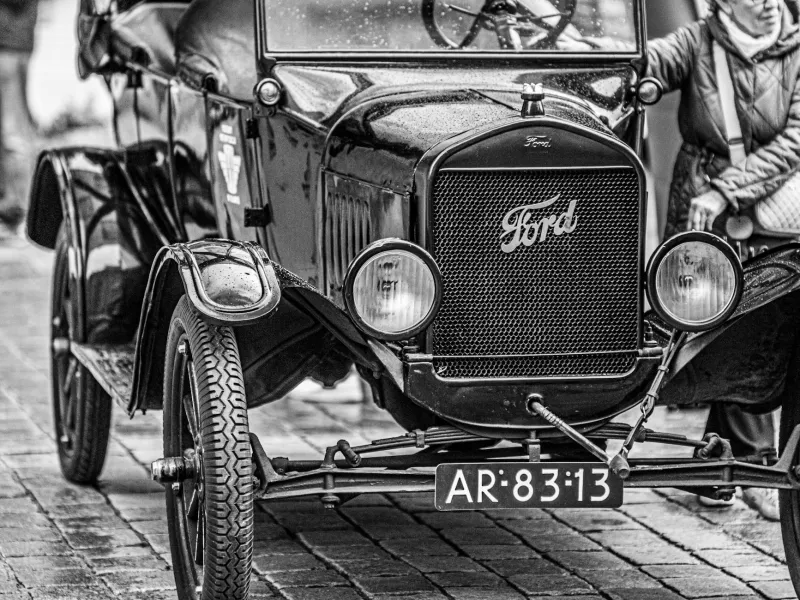
Picture this: you're driving a 1915 Ford Model T down a dusty American road, and you need to back up. There's no mirror to check, no beeping sensor to guide you, no camera display showing what's behind. You simply put the car in reverse, say a prayer, and hope for the best.
This wasn't some oversight in early automotive design — it was just how driving worked. For millions of Americans in the early 20th century, operating a vehicle meant relying entirely on peripheral vision, intuition, and the occasional shout from a helpful passenger.
The Mirror Revolution That Took Decades
The rearview mirror didn't become standard equipment until the 1930s, and even then, many drivers saw it as an unnecessary luxury. Ray Harroun, a race car driver, is credited with mounting the first rearview mirror on his car during the 1911 Indianapolis 500 — not for safety, but to avoid carrying a mechanic as a spotter.
For everyday drivers, the mirror's adoption was painfully slow. Throughout the 1920s, most cars rolled off production lines with no way to see behind them. Backing out of a driveway was a community affair, with family members stationed around the car like traffic controllers at an airport.
Side mirrors arrived even later. It wasn't until the 1960s that passenger-side mirrors became common, and many states didn't require them until the 1980s. The phrase "objects in mirror are closer than they appear" didn't appear until 1966 — meaning generations of American drivers navigated highways with massive blind spots they couldn't even comprehend.
When Changing Lanes Was Pure Guesswork
Consider what highway driving meant in 1950. You're cruising down Route 66 at 45 mph, and you want to pass a slow truck. You have one small mirror showing a narrow slice of road behind you, no side mirrors, and no understanding of blind spots. You signal with your arm out the window, check that tiny rectangle of glass, and hope nothing fast is approaching from your left.
Accidents were inevitable. The National Safety Council reported that backing and merging accidents accounted for nearly 40% of all crashes in the 1950s — a staggering number that today seems almost impossible to achieve.
Truck drivers had it worse. Those massive vehicles had blind spots you could hide a school bus in, and drivers navigated entirely by sound, instinct, and the occasional glimpse in an inadequate mirror. The phrase "if you can't see my mirrors, I can't see you" became trucker wisdom because it was literally a matter of life and death.
The Technology That Changed Everything
Fast-forward to today, and your car knows more about its surroundings than most drivers ever will. Modern vehicles come equipped with rear cameras that activate automatically when backing up, side mirrors with built-in blind spot indicators, and sensors that can detect objects approaching from angles you never thought to check.
The transformation has been dramatic. Today's Honda Civic has more visibility technology than a 1990s luxury car. Backup cameras became mandatory on all new vehicles in 2018, but by then, most manufacturers had already moved far beyond basic rear vision.
Advanced systems now offer 360-degree camera views, showing a bird's-eye perspective of your car's surroundings. Some vehicles can parallel park themselves, using sensors and cameras to navigate spaces their human drivers can't even judge accurately.
Beyond Human Vision
We've entered an era where cars can see things their drivers cannot. Radar-based blind spot monitoring detects vehicles approaching from behind before they're visible in mirrors. Cross-traffic alerts warn of cars approaching from the sides when backing out of parking spaces. Some systems even predict potential collisions and prepare the brakes before the driver realizes danger exists.
This technology has fundamentally changed how we think about driving awareness. A modern car can simultaneously monitor multiple lanes of traffic, track pedestrians on sidewalks, and calculate the speed of approaching vehicles — all while its human operator focuses on the road ahead.
The Disappearing Skill of Spatial Awareness
Yet this technological revolution has created an unexpected consequence. Many drivers today have never developed the spatial awareness that was once essential for survival behind the wheel. The ability to judge distances, estimate speeds, and navigate by feel — skills that every driver possessed in 1950 — are becoming as rare as manual transmissions.
Driving instructors report that new drivers often struggle when technology fails. Remove the backup camera, and many young drivers become genuinely helpless in parking lots. It's a trade-off that earlier generations couldn't have imagined: we've gained unprecedented awareness of our surroundings, but lost the intuitive understanding of space and motion that once defined skilled driving.
The Road Ahead
The next leap is already arriving. Fully autonomous vehicles will eliminate human blind spots entirely, using LIDAR, cameras, and artificial intelligence to create a complete understanding of the road environment. These systems can track dozens of objects simultaneously, predict their movements, and react faster than human reflexes allow.
We've traveled from drivers who couldn't see behind them to cars that can see around corners. It's a transformation that took a century to achieve, but the gap between then and now feels almost impossible to bridge. The Model T driver navigating by instinct and the Tesla owner relying on Autopilot represent two completely different relationships with the road — and with the very concept of awareness itself.