Every Car on Your Block Used to Have a Personality. Now They All Look Like the Same Soap Bar.
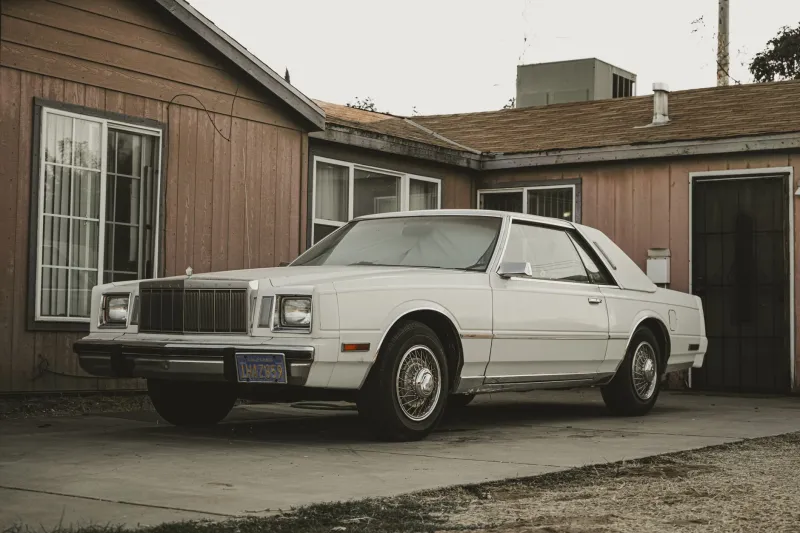
There was a time when you could glance out your front window and narrate your entire neighborhood's driveway without moving from the couch. That boxy, upright Volvo 240 belonged to the Hendersons. The wide, chrome-grilled Buick Electra? That was Mr. Patterson's weekend pride. The little wedge-shaped Toyota Celica with the pop-up headlights? That was clearly someone's college kid visiting for the holidays.
Cars had faces back then. They had character. You knew them the way you knew people.
Now? Walk outside and count how many crossover SUVs you can positively identify without checking the badge. Go ahead. We'll wait.
The Golden Age of Automotive Personality
From the late 1970s through the mid-1990s, American roads were a rolling museum of wildly different design philosophies. Sedans were genuinely boxy. Wagons had wood paneling and rear-facing jump seats. Pickup trucks looked like trucks — utilitarian, upright, zero apologies. Sports cars were wedge-shaped or wide-bodied or dramatically low-slung. Even economy cars had distinct character: the Geo Metro looked nothing like a Honda Civic, which looked nothing like a Ford Escort.
Brands competed aggressively on visual identity. Pontiac had its split grille and wide-track stance. Saab looked like something an aerospace engineer dreamed up during a fever. The Jeep Cherokee XJ — boxy, purposeful, honest — looked like no other vehicle on the road. Even within brands, models were genuinely different from one another. A Ford Mustang and a Ford Taurus shared almost nothing visually, not just mechanically.
This was partly because designers had more freedom, and partly because the engineering constraints were looser. Aerodynamics mattered, but they weren't the only thing that mattered. You could make something that looked interesting and still sell it.
When the Wind Tunnel Took Over
Here's where the gap starts to open up.
As fuel economy regulations tightened — particularly after the 1970s oil crises and then again with increasingly strict CAFE standards through the 2000s and 2010s — automakers discovered that aerodynamic efficiency wasn't just a nice-to-have. It was a competitive weapon. A slipperier shape meant better fuel economy ratings. Better ratings meant regulatory compliance without expensive powertrain engineering.
The problem? Physics doesn't care about brand identity. The most aerodynamically efficient shape for a passenger vehicle is roughly the same regardless of whether it has a Toyota badge or a Volkswagen badge or a Kia badge. It's a smooth, tapered, rounded form with flush surfaces, a raked windshield, and minimal protrusions.
Every automaker ran their clay models through the same wind tunnel logic. And they all arrived at roughly the same answer.
Layer on top of that the global platform-sharing era, where a Nissan Rogue and a Mitsubishi Eclipse Cross might share underlying architecture, and suddenly the visual differences between brands compress even further. Cost-cutting pushed designers toward shared components — door handles, mirror housings, window shapes — that look vaguely similar regardless of the badge.
The Crossover Monoculture
The rise of the crossover SUV is the single biggest driver of visual homogenization in modern automotive history. And it's not a small shift — crossovers now account for roughly half of all new vehicle sales in the United States.
The thing is, crossovers occupy an awkward design space. They're not quite cars, not quite trucks, not quite SUVs. They're a compromise vehicle, and compromise doesn't lend itself to dramatic visual statements. They all need the same basic proportions: a raised ride height, a sloping roofline, a relatively upright front end, and a blunt rear. Once you've established those constraints, you're working in a very narrow design corridor.
Stand in any mall parking lot in America right now and try to pick out the Mazda CX-5 from the Subaru Forester from the Honda CR-V from the Chevrolet Equinox from the Hyundai Tucson. Without walking up to read the badge, it's genuinely difficult. They're all silver. They all have the same vaguely athletic, slightly swoopy silhouette. They're all roughly the same height.
That's not an accident. That's convergent design evolution — the automotive equivalent of every streaming service interface looking exactly the same.
EVs Made It Worse
If crossovers blurred the lines, electric vehicles have nearly erased them.
Without a grille — because EVs don't need engine cooling the same way — designers lost one of the most powerful tools for brand differentiation. The grille was a face. It was where you put your personality. Now, EV front ends are smooth, sealed panels with maybe a thin light bar across them. A Tesla Model Y, a Hyundai Ioniq 5, and a Ford Mustang Mach-E share almost no visual DNA with their brand's heritage, and they look more like each other than they look like anything that came before.
Some EVs have tried to break the mold — the Ioniq 5's pixelated retro-futurism, the Rivian R1T's distinctive front end — but they're exceptions in a category that trends hard toward minimalist uniformity.
What We Actually Lost
This isn't just an aesthetic complaint. There's something genuinely cultural at stake here.
Car design used to be a form of self-expression. The vehicle you drove communicated something about you — not just your income bracket, but your personality, your values, your sense of humor about yourself. A guy in a boxy '85 Volvo wagon was telling a different story than a guy in a third-gen Camaro. A woman in a Jeep Wrangler was making a different statement than one in a Lincoln Town Car.
Now, most Americans are making the same statement: I needed cargo space and decent fuel economy and the financing worked out.
There's nothing wrong with that. But something was lost in translation. The visual richness of the American road — that rolling exhibition of individual taste and regional identity — has quietly faded into a monochrome parade of rounded, sensible shapes.
You used to be able to read a street. Now you just see inventory.
The gap between then and now isn't just about design trends. It's about how much personality we've quietly agreed to give up in exchange for efficiency, compliance, and the comfort of sameness. Whether that trade was worth it probably depends on whether you ever loved a car for the way it looked before you ever sat inside it.