There Was a Time You Could Drive as Fast as You Wanted — Legally
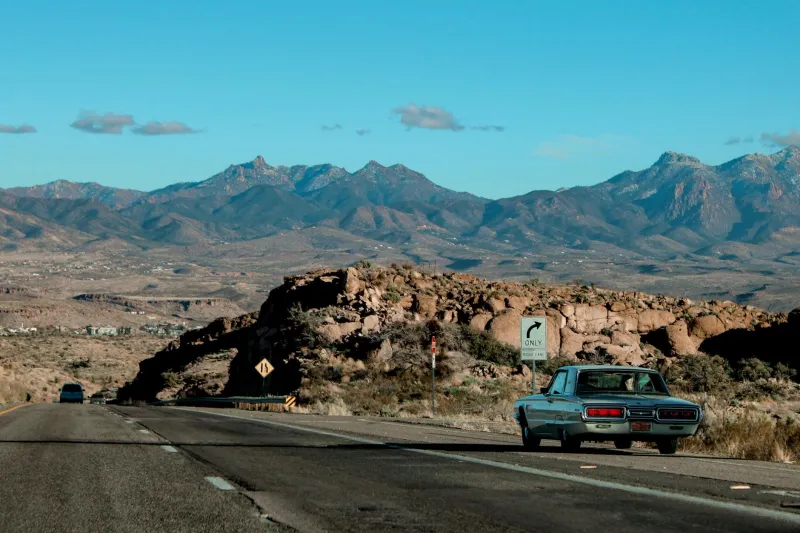
There Was a Time You Could Drive as Fast as You Wanted — Legally
If you were driving across Montana in 1995 and a state trooper pulled you over for going 90 miles per hour, there wasn't a whole lot they could do about it. Montana had repealed its numerical daytime speed limit. The law simply required drivers to travel at a "reasonable and prudent" speed. What counted as reasonable? That was largely up to you.
This wasn't a loophole. It wasn't an oversight. It was a deliberate choice by a state that figured its wide-open highways and sparse traffic didn't need the federal government telling its residents how fast to drive. Montana held out until 1999, when the Supreme Court finally forced the issue.
That small piece of history says a lot about the enormous gap between how America once thought about speed limits and how it thinks about them today.
The Early Days: Rules Nobody Really Made
The first speed limits in the United States were almost comically modest. Connecticut set a limit of 12 mph in cities back in 1901 — before most Americans had even seen an automobile. As cars got faster and roads got busier, states started setting their own limits, but enforcement was inconsistent at best and nonexistent in rural areas.
For most of the early and mid-20th century, highway speed limits were largely a patchwork of state decisions with little federal involvement. Many rural interstates, built during the Eisenhower era in the late 1950s, were engineered to handle speeds well above what was legally posted. Engineers actually designed the geometry of those roads — the banking of curves, the sight-line distances — with speeds of 70 to 75 mph in mind. The legal limit was often lower, but the road itself was practically inviting you to go faster.
In some western states, daytime speed on open highways was essentially unregulated. You were expected to use judgment. The culture of driving in those years carried a different weight — the open road was freedom in a very literal sense, and putting a number on that felt wrong to a lot of people.
The Oil Crisis Changed Everything
In October 1973, OPEC announced an oil embargo targeting the United States. Gas prices spiked. Lines formed at stations across the country. And in Washington, the Nixon administration went looking for ways to cut fuel consumption fast.
The answer they landed on was speed. Studies showed that fuel efficiency dropped sharply above 55 mph. So in January 1974, Congress passed the Emergency Highway Energy Conservation Act, setting a national maximum speed limit of 55 mph on all U.S. highways. It was sold as a temporary wartime-style measure. It lasted 21 years.
Drivers hated it. On western interstates built for 75 mph, crawling along at 55 felt absurd. CB radios — which had a massive cultural moment in the mid-1970s — became tools for truckers and regular drivers to warn each other about speed traps. The 1977 film Smokey and the Bandit wasn't just entertainment. It was a cultural expression of how many Americans felt about the 55 mph limit: it was an obstacle to be outsmarted, not a rule to be respected.
Compliance was famously poor. The federal government threatened to withhold highway funding from states that didn't enforce the limit, but enforcement was uneven and often theatrical.
By 1987, Congress allowed states to raise limits to 65 mph on rural interstates. And in 1995, the national speed limit was repealed entirely, handing full control back to the states.
The Patchwork We Live With Today
What followed the repeal was a gradual, state-by-state ratcheting upward of limits across much of the country. Texas currently holds the record, with an 85 mph limit on a toll road between Austin and San Antonio — the highest posted speed limit in the United States. Several other states have pushed limits to 80 mph on certain rural interstates.
At the same time, enforcement has become dramatically more sophisticated. Radar guns have been replaced in many jurisdictions by LIDAR, which is harder to detect and more accurate. Speed cameras — almost unheard of in the U.S. before the 2000s — now operate in school zones, work zones, and city corridors in states like Illinois, New York, and Oregon. Some cities use automated systems that mail tickets without a human officer ever being involved.
The result is a strange paradox: legal limits are higher in many places than they've been in decades, yet the tools for catching you when you exceed them are more pervasive and precise than ever. The open-road freedom of the early interstate era has given way to a monitored, algorithmically enforced highway system that would have seemed like science fiction to a trucker running radar in 1977.
What the Speed Limit Debate Was Really About
Speed limits have always been about more than safety statistics. They've been a proxy for a bigger argument about who controls the road — the individual driver or the state. The 55 mph era crystallized that tension in a way that still echoes today. When Montana briefly let drivers decide for themselves what "reasonable" meant, it was making a philosophical statement as much as a traffic policy.
Today's system is messier and more contested than either side in that old debate probably wanted. Limits vary wildly from state to state. Enforcement is uneven. And the cultural attitude toward speed — that slight pressure of the right foot that most drivers apply somewhere above the posted number — hasn't disappeared. It's just been quietly negotiated with the technology watching from the shoulder.
The gap between the wide-open throttle of America's early highway era and today's camera-monitored roads is vast. Whether that gap represents progress, loss, or just the complicated reality of a country that still can't quite agree on what the open road is supposed to mean — that's a question every driver answers for themselves, one mile at a time.