When Your Car Radio Cost More Than Your Car — Now Your Dashboard Runs Your Entire Life
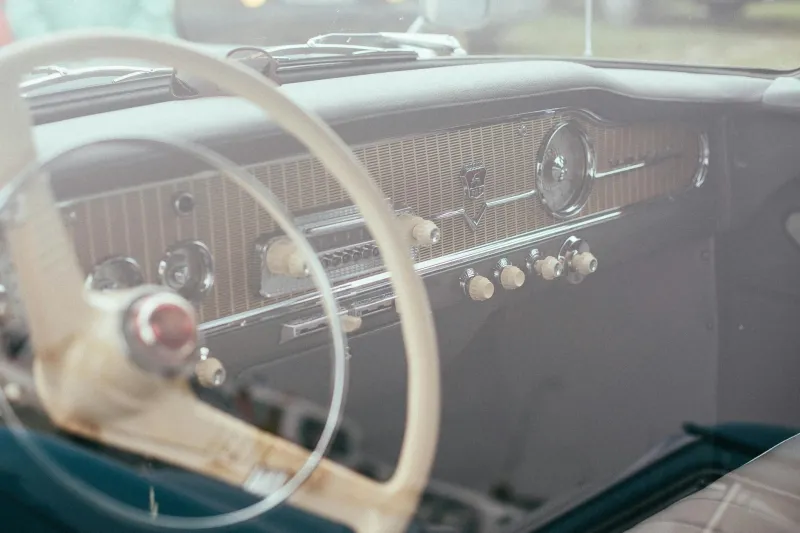
Picture this: You're shopping for a new car in 1930, and the dealer mentions they can install a radio for just $130 extra. That doesn't sound like much until you realize the car itself costs $600. You're essentially being asked to pay 22% more for the privilege of listening to crackling AM broadcasts while you drive.
When Radio Was Revolutionary
The first car radio, introduced by Motorola in 1930, was called the "5T71" — a name that sounds more like a government filing code than entertainment technology. Installing one required cutting holes in your dashboard, running wires throughout the car, and mounting a massive antenna that made your vehicle look like it was ready to contact extraterrestrials.
But here's the kicker: many people thought car radios were a terrible idea. Massachusetts actually considered banning them entirely, arguing that drivers would be too distracted by music and news to pay attention to the road. Police departments worried that criminals would use car radios to monitor emergency frequencies. Some insurance companies even refused to cover accidents involving cars with radios.
The technology itself was primitive by today's standards. The radio required its own separate battery, which often died at the worst possible moments. Reception was spotty at best — driving under a bridge or past a large building could turn your favorite song into static soup. And forget about choosing what to listen to; you got whatever the local AM station decided to broadcast.
The Long Road to Entertainment
For decades, car audio evolved at a snail's pace. FM radio arrived in the 1950s but didn't become standard until the 1970s. Eight-track players gave way to cassette decks, which eventually surrendered to CD players. Each innovation was treated as revolutionary, yet each still left drivers at the mercy of whatever media they remembered to bring along.
Even as late as the 1990s, a premium car stereo system meant having a graphic equalizer with sliding bars that made you feel like a sound engineer. The height of luxury was a multi-disc CD changer hidden in your trunk, allowing you to switch between six albums without stopping the car.
Your Dashboard Became Mission Control
Now look at your car. That screen in the center of your dashboard has more computing power than the room-sized computers that guided Apollo missions to the moon. Your "car radio" can access millions of songs instantly through Spotify or Apple Music. It knows your location, your destination, and the fastest route to get there while avoiding traffic jams in real-time.
But calling it a radio seems almost insulting. Today's infotainment systems are essentially smartphones welded to your dashboard. They can read your text messages aloud, make phone calls with crystal-clear audio, and even video chat with your family when parked. Some systems learn your preferences and automatically adjust climate control, seat position, and music selection based on who's driving.
Voice control has eliminated the need to touch anything at all. You can ask your car to find the nearest gas station, change the temperature, or skip to your favorite song — all while keeping your eyes on the road. The same technology that Massachusetts once wanted to ban for being too distracting now helps prevent distracted driving.
The Connected Revolution
The real game-changer is connectivity. Your car doesn't just play entertainment; it's become a rolling computer that receives over-the-air software updates like your iPhone. Tesla owners regularly wake up to find their cars have gained new features overnight — improved autopilot capabilities, new games, or enhanced performance settings downloaded while they slept.
Modern cars can diagnose their own problems and schedule service appointments automatically. They can start themselves remotely on cold mornings, unlock when they sense your phone approaching, and even park themselves in tight spaces. Some vehicles can serve as mobile WiFi hotspots, turning every passenger into a connected device.
The Price Tag Flip
Here's the most dramatic change: while that 1930 radio cost 22% of the car's value, today's sophisticated infotainment systems often come standard in economy vehicles. A base model Honda Civic includes technology that would have seemed like science fiction just twenty years ago. The features that once defined luxury cars — navigation, premium audio, smartphone integration — are now expected in every price range.
Meanwhile, aftermarket car stereo shops have largely disappeared. Why modify your dashboard when your car already does everything your phone can do, plus things your phone can't — like integrate with your vehicle's safety systems and engine diagnostics?
The Road Ahead
We've traveled from fearing radio as a driving distraction to embracing artificial intelligence as our co-pilot. Your car's dashboard has evolved from a collection of analog gauges into a command center that manages entertainment, navigation, communication, and vehicle systems simultaneously.
The gap between 1930's $130 radio and today's AI-powered infotainment systems represents more than technological progress — it shows how completely we've reimagined what a car should be. We've gone from vehicles that simply transported us to mobile extensions of our digital lives.
And somehow, we're safer drivers because of it.