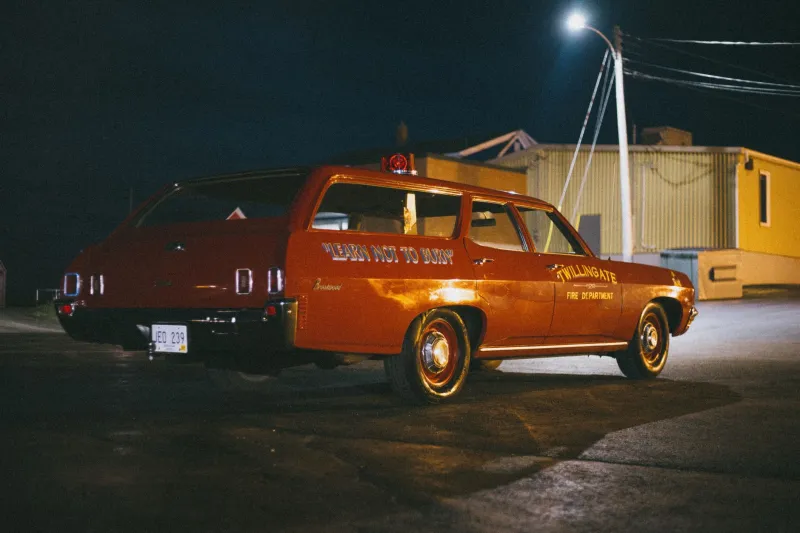
Chrome Dreams and Clay Hands — Before Software Decided What Beautiful Looked Like

Somewhere in a Detroit studio in 1953, a man named Virgil Exner was crouched over a clay model, shaping a rear fender skirt with his bare hands. He wasn't thinking about drag coefficients. He wasn't running simulations. He was thinking about jet planes, about the American Dream, about what a family in Omaha would feel when they pulled into church on Sunday morning driving something that looked like it belonged in orbit.
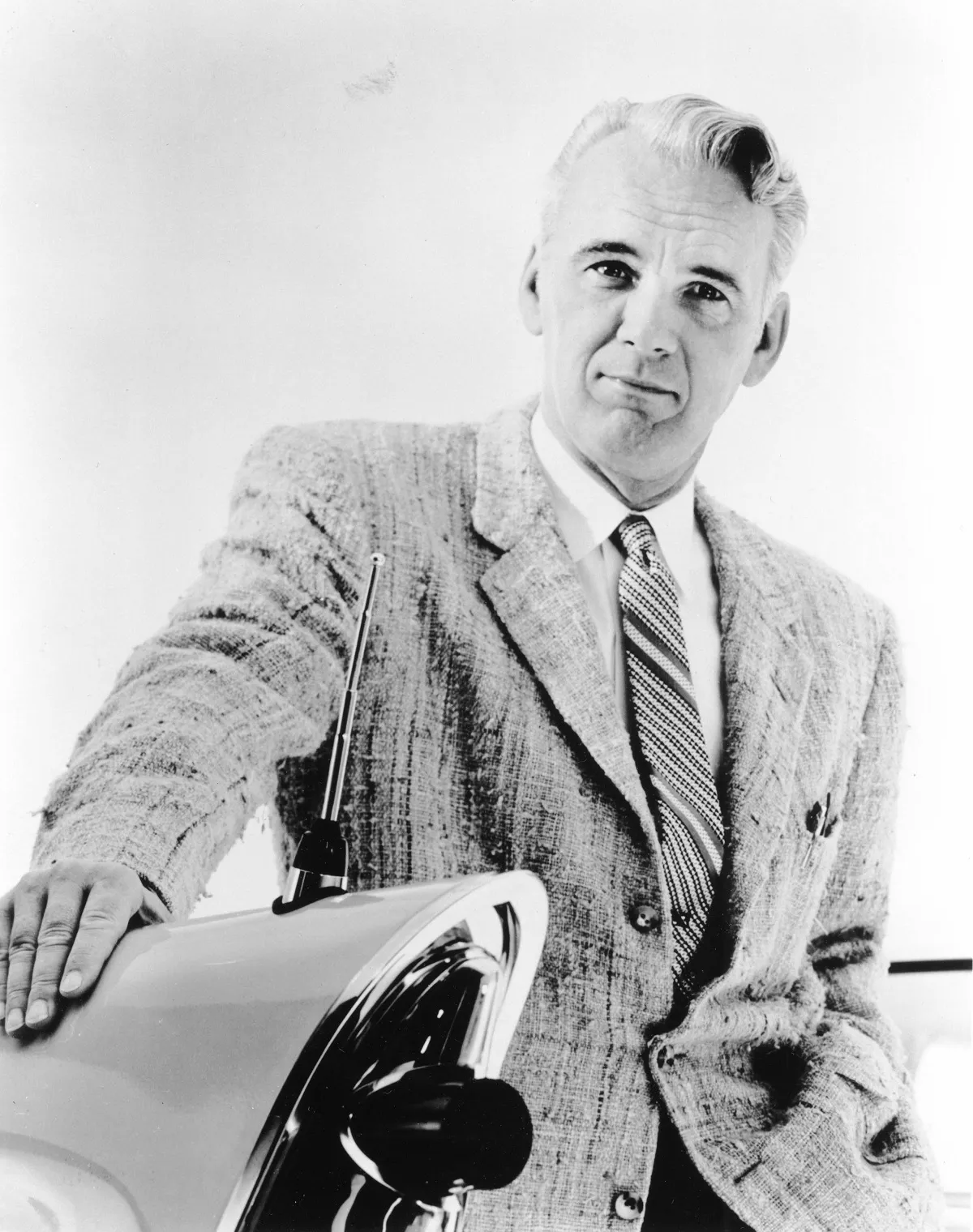 Photo: Virgil Exner, via assets.dyler.com
That car would eventually become a Chrysler. And it would stop traffic.
Nobody stops traffic anymore.
The Age of Rolling Sculpture
Post-war America was hungry — for optimism, for prosperity, for proof that the country had won more than just a war. The automobile became the canvas for all of that ambition. Car designers in the late 1940s and throughout the 1950s weren't engineers first. They were storytellers. They were artists who happened to work in steel and chrome.
Fender skirts — those smooth, teardrop-shaped panels that covered the rear wheel wells — weren't functional. They didn't make the car faster. They didn't improve fuel economy. They existed purely to make a car look like it was already moving at 90 miles per hour while sitting perfectly still in a dealership lot. And Americans loved them for exactly that reason.
Hood ornaments were another story entirely. The 1951 Pontiac had a Native American chief rising from the hood in chrome. The 1956 Packard Caribbean wore a pelican. Cadillac's goddess — a sleek, forward-leaning figure known as La Salle — told you everything you needed to know about who was driving before you ever saw the driver. These weren't decorations. They were declarations.
Then came the tail fins.
Harley Earl, the legendary GM designer who essentially invented the concept of automotive styling as a discipline, saw a Lockheed P-38 Lightning fighter plane in 1941 and never got over it. By 1948, the Cadillac was sprouting small fins at the rear. By 1959, those fins had become full-blown architectural statements — soaring chrome-tipped structures that served no aerodynamic purpose whatsoever and were absolutely magnificent because of it.
 Photo: Lockheed P-38 Lightning, via wallpapercave.com
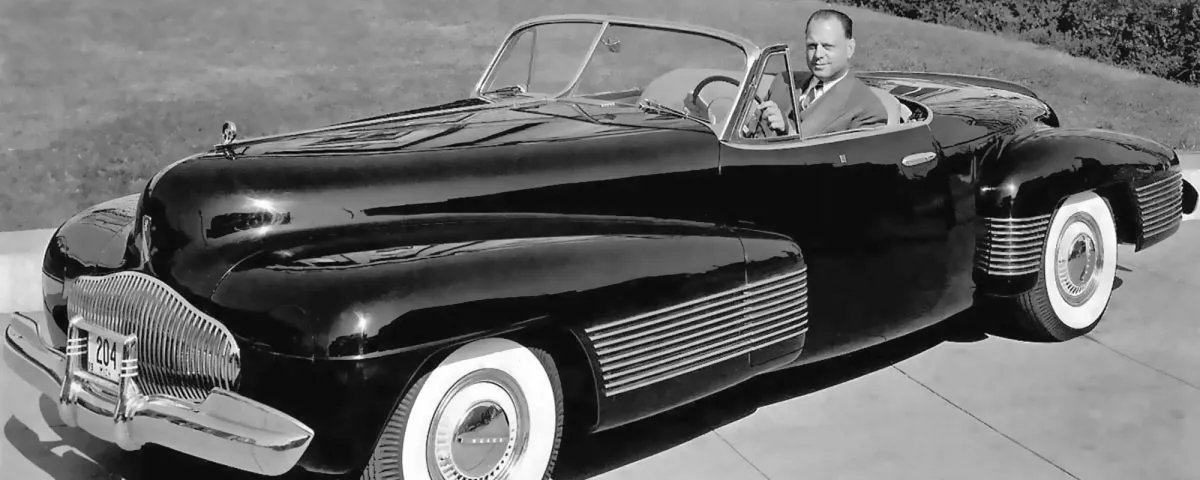 Photo: Harley Earl, via assets.dyler.com
A 1959 Cadillac Eldorado didn't just drive down the street. It announced itself.
What Happened to All That Personality
The short answer is: the oil crisis happened. Then safety regulations. Then globalization. Then computer-aided design.
Each of those things, individually, was largely good. Fuel efficiency saved money and reduced pollution. Safety standards saved lives. Computerized design tools gave engineers precision that human hands simply couldn't match. Nobody is arguing that we should go back to cars without airbags so we can have prettier hood ornaments.
But somewhere in that long march toward rationality, something genuinely irreplaceable got left behind.
Modern car design is governed by a number called the drag coefficient — a measure of how efficiently a shape moves through air. A lower number means less wind resistance, which means better fuel economy, which means better EPA ratings, which means better sales. The 2024 Mercedes EQS has a drag coefficient of 0.20. It is an extraordinary engineering achievement. It also looks like a bar of soap that got slightly nervous.
Every curve on a modern car exists because a computer approved it. Every surface angle has been tested in a virtual wind tunnel thousands of times before a single prototype is built. The cars that result are genuinely impressive — they're safer, cleaner, more efficient, and more reliable than anything Virgil Exner ever dreamed of. But you wouldn't know one from another in a dark parking lot.
The Sameness Problem
Walk through any American parking lot today and count how many cars you can identify without looking at the badge. The crossovers all share the same raked roofline, the same blacked-out pillars, the same pinched rear end. The sedans have been aerodynamically massaged into near-identical teardrop shapes. Even the colors have converged — gray, white, black, and silver account for roughly 80 percent of new vehicles sold in the United States.
This isn't an accident. It's the logical endpoint of optimization. When every design decision is filtered through the same set of efficiency requirements, regulatory standards, and cost constraints, you get cars that are all excellent and almost completely indistinguishable.
The 1957 Chevrolet Bel Air came in 16 colors with names like Matador Red, Larkspur Blue, and Colonial Cream. It had a chrome grille that smiled at you. It had a dashboard that looked like it belonged in a cocktail lounge. It had character — the kind that made people fall in love with specific cars rather than just specific trim levels.
What We Actually Lost
This isn't just nostalgia talking. There's something culturally significant about the shift from cars as expressions of identity to cars as efficient transportation appliances.
When a car had a face — a real face, with a grille that grinned or scowled, with headlights that suggested eyes, with fins that implied flight — it had a relationship with its owner that went beyond the transactional. People named their cars. They washed them on Saturday afternoons with the same care you'd give a prized possession. They argued about which brand was better the way people now argue about sports teams.
That emotional connection wasn't irrational. It was a response to objects that had genuine personality baked into them by human beings who cared about more than efficiency.
Today's designers aren't talentless — the interiors of modern cars are often genuinely beautiful, and some manufacturers are pushing back against the sameness with distinctive styling choices. But they're working within constraints that would have been unimaginable to Harley Earl. Every decision runs through a gauntlet of regulatory requirements, aerodynamic targets, pedestrian safety standards, and cost-per-unit calculations before it ever reaches the clay stage.
The clay stage that used to be the beginning of the conversation is now closer to the end.
The Gap
The fender skirt is gone. The hood ornament is mostly gone — liability concerns made them a legal risk decades ago. The tail fin never came back and probably never will. What replaced them is objectively better in almost every measurable way.
But measurement was never really the point, was it?
The cars of the 1950s were impractical, gas-hungry, mechanically unreliable, and frequently unsafe. They were also genuinely, unapologetically beautiful in a way that made people feel something. They reflected a cultural moment — a country drunk on its own possibility, expressing that optimism in chrome and steel and the kind of creative confidence that doesn't ask permission from a wind tunnel.
We traded all of that for 0.001 less drag. It was probably the right call. It just doesn't feel like it when you're staring at another gray crossover in another gray parking lot, trying to remember which one is yours.