Your Grandfather Tried to Hide the Rust. Now Bentley Charges Extra for It.
Somewhere in a garage in the Midwest, there's a man in his seventies who spent an entire Saturday in 1978 with a wire brush, a can of Rustoleum, and a level of personal shame that would surprise you. He had a rust spot on the rear quarter panel of his Chevy. Maybe two inches across. He attacked it like it was a personal failing — because in the automotive culture of that era, it basically was.
Rust was decay. Decay meant neglect. Neglect meant you either couldn't afford to maintain your car or didn't care enough to. Neither was acceptable. In the used car market, visible rust was nearly a death sentence for resale value. Dealers would point to it during negotiations with the casual confidence of a surgeon delivering bad news. Buyers would walk away. The rust had to go.
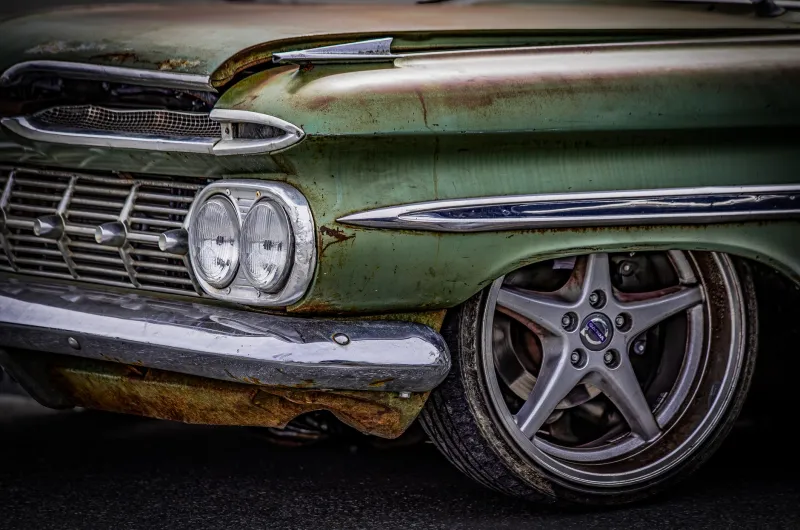
Fast forward to 2024. Rolls-Royce offers a bespoke finish program through its Coachbuild division where clients can commission paint effects that deliberately mimic the look of aged, weathered metal. Porsche has offered "patina" options through its Exclusive Manufaktur customization service. Restoration shops in California charge five figures to apply a hand-distressed finish to a truck that will never see a dirt road. And on the collector car market, original untouched paint — complete with chips, fading, and oxidation — commands premiums that a freshly restored example simply can't match.
The rust didn't change. Our relationship to it did.
The Era When Decay Was the Enemy
To understand how dramatic this reversal is, you have to understand what rust actually meant to the American car owner in the postwar decades. It wasn't just cosmetic.
Through the 1950s, 60s, and well into the 70s, American automakers were not exactly distinguished by their metallurgical discipline. Steel quality was inconsistent, rustproofing was minimal or nonexistent, and road salt — used heavily in the Rust Belt and Northeast — ate through body panels with almost biological aggression. A car bought new in 1965 might have visible surface rust within three years and structural rust within five. By year eight or nine, floor pans could be soft enough to be a genuine safety concern.
This wasn't a fringe problem. It was so widespread that entire regional markets developed different reputations. A car from the South or Southwest was worth more than an identical car from Michigan or Ohio, purely because of rust exposure. The phrase "southern car" in a classified ad wasn't just geography — it was a value proposition.
Owners responded accordingly. Rustproofing treatments became a booming aftermarket industry in the 1970s. Ziebart locations appeared in strip malls across the country, offering undercoating and cavity treatments that promised to slow the inevitable. Body shops did brisk business in Bondo and spray paint. The goal was simple: make it look like it wasn't happening. Hide the evidence. Protect the resale.
How Japan Changed the Chemistry
The quality revolution of the 1980s — driven largely by Japanese manufacturers who arrived with significantly better corrosion resistance built into their vehicles — began to change what consumers expected from a car's longevity. A Honda Civic from 1983 that still looked clean in 1993 reset the baseline. If a car could last without rusting, then a car that did rust was a product of either inferior manufacturing or owner negligence.
American manufacturers eventually caught up, and by the 1990s, most new vehicles came with meaningful corrosion warranties. The problem didn't disappear, but it receded. Rust became less of an inevitability and more of an anomaly — which, counterintuitively, set the stage for it to become interesting.
The Aesthetics of Imperfection
The cultural shift started in the custom and collector car world, where it has roots going back further than most people realize. Hot rod culture always had a strand of anti-polish running through it — the primer-gray "rat rod" aesthetic that deliberately rejected the show-car gleam in favor of something rawer and more honest. But what was once a niche stance within a niche hobby has migrated, dramatically, into the mainstream luxury market.
The mechanism driving this is partly generational and partly economic. As the generation that feared rust ages out of peak car-buying years, the buyers replacing them have a different relationship to authenticity. Younger affluent consumers, shaped by a culture that prizes the handmade, the imperfect, and the non-reproducible, are drawn to things that look like they have a story. A perfectly uniform factory finish is, in this frame, almost a mark against something. It's anonymous. It could be anyone's.
A patinated surface, by contrast, is unrepeatable. No two pieces of weathered metal look exactly alike. The fading, the variation in tone, the micro-texture of oxidized paint — these are, in the language of contemporary luxury, provenance made visible.
The economics followed the aesthetics. Auction results for "barn find" vehicles — discovered after decades of storage, often with original paint still intact but heavily aged — began routinely outperforming restored examples of the same car. A numbers-matching muscle car with original but tired paint became, in certain collector circles, worth more than a freshly restored twin. The market was pricing authenticity over perfection.
What You Pay for Imperfection Now
The luxury end of this trend is where it gets genuinely surreal. Premium automakers have recognized that their customers want exclusivity, and exclusivity increasingly means the hand-applied, the irregular, the deliberately imperfect. Bespoke paint finishes that mimic the tonal variation of aged metal can add tens of thousands of dollars to the price of a vehicle. Restoration shops offering "preserved" rather than "restored" finishes charge premiums for the labor of making something look like it wasn't touched.
The man in the Midwest with his Rustoleum and his wire brush was trying to erase something that a Rolls-Royce customer in 2024 might specifically request. That's not a small gap. That's a complete inversion of values — and it happened in less than fifty years.